Beginner’s Guide to Growing Roses
New to Roses? This practical guide covers where to start, how to choose the right type of Rose, and the basics of planting and care so you can grow with confidence.
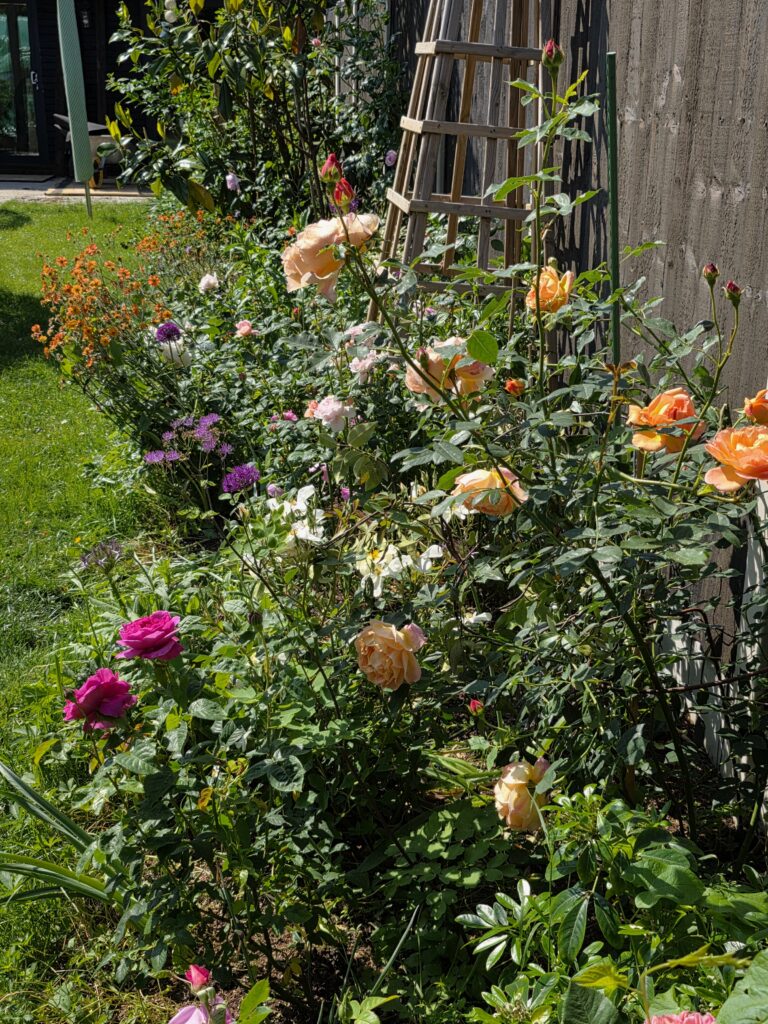
Growing Roses can feel intimidating at first. There is so much advice about pruning, feeding, disease, and which varieties to choose that it is easy to assume they are difficult plants. In reality, Roses are far more manageable once you understand a few key basics.
The best place to start is not with complicated pruning rules or specialist products. Instead, begin by choosing the right Rose for your space, understanding the difference between Shrub Roses and Climbing Roses, deciding whether a bare-root Rose or potted Rose suits your timing, and getting the planting basics right. Once those foundations are in place, growing Roses becomes much less overwhelming and much more enjoyable.
If you are new to Roses, this guide will walk you through exactly where to begin.
Why grow Roses?
There is a reason so many gardeners fall in love with Roses. They bring beauty, structure, and a long season of interest to a garden. Some Roses also have a wonderful fragrance, although scent can vary a lot from one variety to another.
Just as importantly, modern Roses are often much easier to grow than people expect. With the right variety and a good start, they can be reliable, rewarding plants for beginners.
It is also worth remembering that not every beautiful Rose is strongly scented. Some varieties are chosen more for their health, flowering performance, colour, or overall garden impact. So if fragrance matters to you, check that before you buy rather than assuming every Rose will smell the same.
Start with the right Rose
Before you think about planting, it helps to choose a Rose that suits both your space and your confidence level. Not every Rose grows in the same way, and some are naturally easier for beginners than others.
As a general rule, look for varieties that are:
- repeat flowering
- healthy and disease-resistant
- suited to your available space
- happy in your garden conditions
- sold by a reputable nursery
When choosing a Rose, it also helps to think about what matters most to you. Some gardeners prioritise scent, while others care more about flower power, repeat blooming, health, colour, or growth habit. Not all Roses are strongly scented, and some of the most beautiful, reliable varieties are grown more for their performance than their fragrance.
For example, if you want a rounded Rose for a border, bed, or large container, a Shrub Rose is often the best place to start. If you want to grow upwards over a wall, fence, arch, trellis, or obelisk, a Climbing Rose will usually be the better fit.
Although it is tempting to choose purely by flower shape or colour, a beginner-friendly Rose that suits the space will usually give you a much better experience.
Shrub Rose or Climbing Rose?
Before buying a Rose, it helps to decide what role you want it to play in the garden. One of the most useful early choices is whether you need a Shrub Rose or a Climbing Rose.
Both can be grown in the ground, and both can also be grown in pots or planters if the container is generous enough. The main difference is how they grow and the kind of space they suit best.
What is a Shrub Rose?
A Shrub Rose grows as a rounded, bushy plant and is often the easiest type for beginners to place in the garden. It works beautifully in borders, mixed planting schemes, and large pots or planters.
Choose a Shrub Rose if you want:
- a fuller, bushier shape
- a Rose that mixes well with other plants
- something for a border, bed, or large container
- a simpler starting point for learning how Roses grow
What is a Climbing Rose?
A Climbing Rose produces long stems that are trained against a support such as a wall, fence, arch, obelisk, or trellis. It can be grown in the ground or in a large pot or planter, provided there is enough root space and something sturdy to train it onto.
Choose a Climbing Rose if you want:
- height in the garden
- to cover or soften a wall or fence
- to grow over an arch, trellis, or obelisk
- to make use of vertical space
Why this matters
This choice helps you match the right Rose to the right spot.
For example, a Shrub Rose is usually the better fit if you want a rounded plant to anchor a border or sit beautifully in a large container. A Climbing Rose, on the other hand, is the better choice if you want to draw the eye upwards or cover a structure. Both can work in pots, but the container size and final placement matter much more than people often realise.
So before choosing a variety, ask yourself:
- Do I want height or a bushier shape?
- Am I filling a border, styling a pot, or covering a structure?
- Do I have enough room for the mature plant?
- If I want a climber, do I have support in place?
- If I am using a pot or planter, is it large enough?
Once you answer those questions, choosing the right type of Rose becomes much easier.
Bare-root Roses vs potted Roses
Another early decision is whether to buy a bare-root Rose or a potted Rose. Both can be excellent choices, but they suit slightly different situations.
What is a bare-root Rose?
A bare-root Rose is sold while dormant, without a pot of compost around its roots. These are usually available from late autumn to early spring.
In many cases, bare-root Roses are:
- more affordable
- easy to order by mail
- excellent for planting in the ground during the dormant season
- a great option if you want good value
Because they are sold while not actively growing, they can look a little underwhelming at first. Even so, do not let that put you off. A healthy bare-root Rose often catches up beautifully once planted.
What is a potted Rose?
A potted Rose is sold in a container with compost around the roots. These are often available for a longer part of the year, especially in spring and summer.
For beginners, potted Roses can feel easier because:
- you can see more of the plant
- they look more established when you buy them
- they are easier to visualise in a border, pot, or planter
- they can be planted over a wider window, provided conditions are suitable
However, they are often more expensive than bare-root Roses.
Which is best for beginners?
Neither is automatically better. Instead, the right choice depends on timing, budget, and confidence.
Choose a bare-root Rose if:
- you are planting from autumn to early spring
- you want the best value
- you are happy to start with a dormant plant
Choose a potted Rose if:
- you are shopping outside the bare-root season
- you want a more visible, established-looking plant
- you feel more confident starting with something already in growth
If you are planting into the garden during the right season, bare-root Roses are a brilliant place to begin. On the other hand, potted Roses are very useful if you want flexibility or are planting later.
When to plant Roses
Timing matters, but it does not need to be complicated.
Bare-root Roses are usually planted from late autumn through to early spring, while they are dormant. This is often one of the best times to plant because the roots can settle in before strong spring growth begins.
Potted Roses can be planted more flexibly. Spring and autumn are particularly good, although summer planting is still possible if you are prepared to water consistently. During very hot or dry spells, newly planted Roses will need more attention.
Whenever you plant, avoid working the ground if it is frozen or waterlogged.
Choose the right spot
Most Roses do best in a position with plenty of sunlight, good airflow, and fertile soil. Ideally, aim for a spot with around six hours of sun a day or more.
That said, gardening is rarely about perfect conditions. Some Roses will tolerate a little shade better than others, and many gardens have awkward areas. Even so, beginners will usually have the easiest time if they start with a sunny, open position.
When choosing a planting spot, think about:
- sunlight through the day (minimum of 6 hours)
- how much room the Rose will need as it matures
- airflow around the plant
- whether the soil drains reasonably well
- how easy it will be for you to water and maintain it
Heavy clay soil does not automatically mean failure. In fact, Roses can do very well in clay if you improve the planting area and avoid letting it become compacted or waterlogged.
Growing Roses in pots and planters
You can absolutely grow Roses in pots and planters. In fact, containers are a brilliant option if you have a patio, a smaller garden, or simply want more flexibility in your planting.
Both Shrub Roses and Climbing Roses can be grown this way, but success depends on choosing a container that gives the roots enough room.
As a general rule, the bigger the pot or planter, the better. A container that is too small will dry out quickly, restrict root growth, and make the Rose harder to keep healthy. Large pots and generous planters give the plant a much better chance of settling in and performing well.
If you are growing a Rose in a pot or planter, choose:
- a large container with drainage holes
- a Rose suited to container growing
- a good-quality compost
- a sunny position
- room for airflow around the plant
- support if you are growing a Climbing Rose
Container-grown Roses do need slightly more attention than those in the ground. Because the compost dries out faster, they need more frequent watering and feeding, especially in warm weather. Even so, the reward is well worth it, and a Rose in a beautiful pot can be a real feature.
How to plant a Rose in the ground
Once you have chosen your Rose and your planting spot, the next step is getting it into the ground properly.
Planting a bare-root Rose
First, soak the roots in water for a couple of hours before planting. Meanwhile, dig a generous hole wide enough to spread the roots out comfortably.
Then add some well-rotted farmyard manure into the planting area to enrich the soil, mixing it through rather than leaving it as a thick layer. You can also add Mycorrhizal Fungi around the roots at planting time to help the Rose establish more effectively.
After that, position the Rose so the graft union, if visible, sits at the right level for your conditions. In many UK gardens, that usually means slightly below soil level, especially in colder areas. Then backfill the hole, firm the soil gently, and water well.
Planting a potted Rose
Start by watering the plant in its pot. Then remove it carefully and loosen any congested roots if needed.
Dig a hole slightly wider than the rootball and around the same depth. Add some well-rotted farmyard manure into the planting area to improve the soil, and sprinkle Mycorrhizal Fungi if you use it to support root establishment. Place the Rose so it sits at the same level it was growing in the pot. Then backfill, firm gently, and water well.
After planting
Whichever type you choose, finish with a generous watering and a layer of mulch around the base, keeping it clear of the stems. This helps retain moisture, improves the soil, and gives the plant a stronger start.
How to plant a Rose in a pot or planter
Planting a Rose in a pot or planter follows the same basic idea, but container growing does make those early choices more important.
Start with a large pot or planter with good drainage. Then fill it with suitable compost, leaving enough room to position the plant at the correct level.
If you are planting a potted Rose, water it first, remove it from the nursery pot, and place it so the top of the rootball sits neatly below the rim of the container. After that, backfill around it, firm gently, and water thoroughly.
If you are planting a bare-root Rose into a planter, soak the roots first, dust or sprinkle Mycorrhizal Fungi around the roots if you are using it, and spread them out carefully as you plant. Again, water well once finished.
For a Climbing Rose, it also helps to have the support in place from the start so you can begin training the stems early.
How to care for Roses after planting
Once your Rose is in place, the care routine becomes much simpler.
Watering
Newly planted Roses need regular watering while they establish. During dry spells, this becomes especially important.
Water deeply rather than little and often. That way, the moisture reaches the roots properly and encourages stronger root development.
Potted and planter-grown Roses will dry out faster, so check them more often, especially in warm weather.
Feeding
Roses are hungry plants, so feeding helps them produce healthy growth and plenty of flowers. Use a suitable Rose fertiliser in the growing season, following the instructions on the product.
Generally, feeding starts in spring as growth begins. After that, a second feed later in the season may be useful, depending on the product and the plant’s performance.
Mulching
A good mulch improves the soil, holds moisture, and helps suppress weeds. Apply it around the base of the plant in spring, but keep it away from direct contact with the stems.
Deadheading
For repeat-flowering Roses, deadheading helps keep the plant tidy and encourages more blooms. Simply remove spent flowers by cutting back to a healthy leaf.
Not all Roses need deadheading in the same way, though, so it is always worth checking the habit of your chosen variety.
Common beginner mistakes
Every gardener makes mistakes, especially at the beginning. Fortunately, most Rose problems come down to a few fixable issues.
Choosing the wrong Rose for the space
A Rose that grows far larger than expected, or in a completely different shape, can quickly become awkward. Always check the mature size and growth habit before planting.
Using a pot that is too small
This is one of the easiest mistakes to make. A Rose may look fine in a small pot at first, but over time it will struggle if the roots do not have enough space.
Letting pots dry out
Container-grown Roses need closer attention in warm weather. If they dry out repeatedly, performance will suffer.
Forgetting support for climbers
A Climbing Rose needs something sturdy to grow against. Without support, it will not give you the effect you were hoping for.
Planting in too much shade
Although some varieties cope better than others, most Roses perform best with plenty of sun. In too much shade, flowering is often reduced and growth can become weaker.
Overcomplicating things
This is perhaps the biggest one. Beginners often think they need to know everything immediately. In truth, you do not need to master every aspect of Rose care on day one. Start well, pay attention, and learn as you go.
Are Roses hard to grow?
Not necessarily. They can be fussy in the wrong conditions, but they are not impossible plants reserved for expert gardeners.
In fact, if you choose a healthy variety, plant it well, and keep up with the basics, Roses are surprisingly rewarding. The key is to begin with realistic expectations and good foundations rather than assuming you need specialist knowledge from the start.
A simple beginner checklist
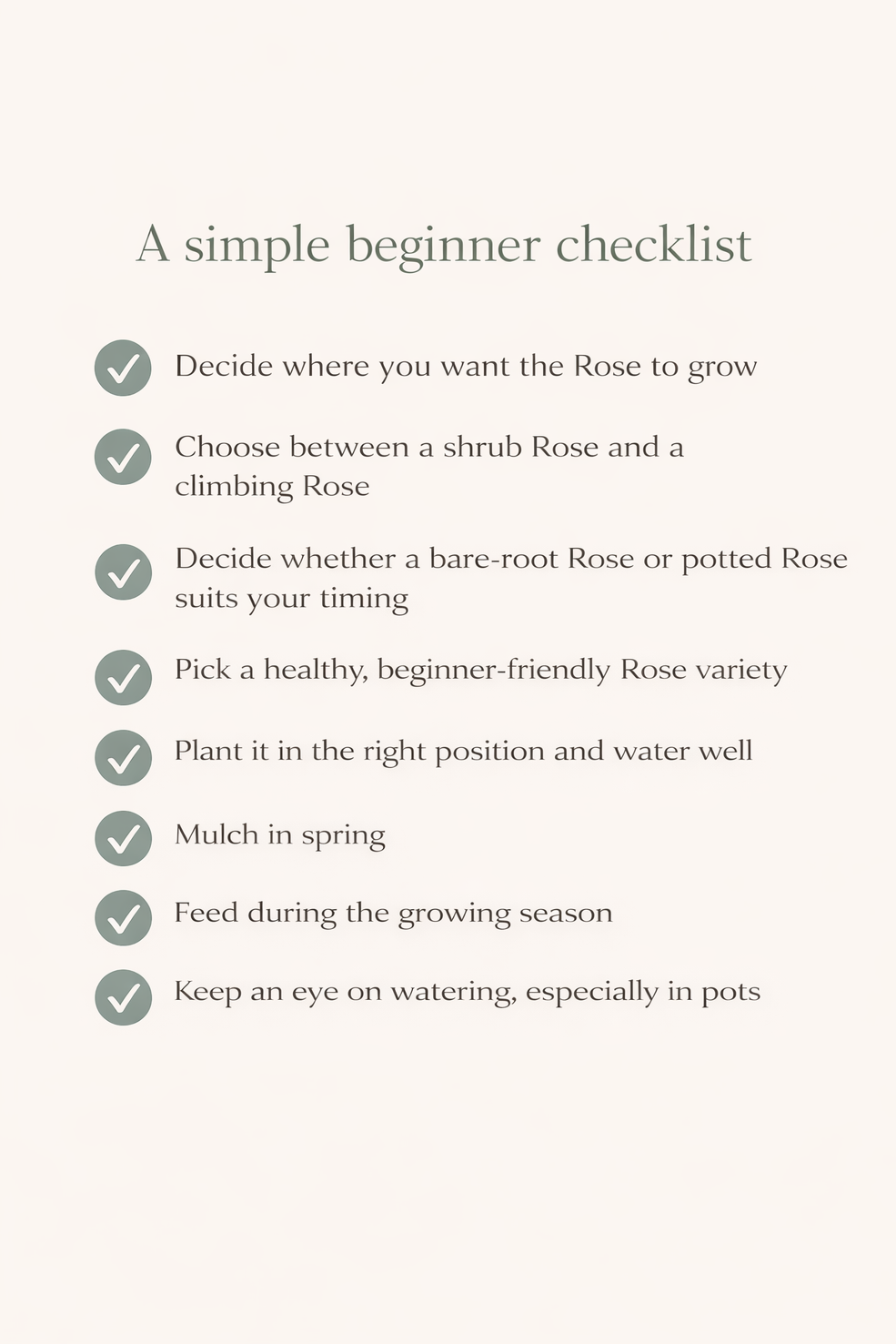
Growing Roses for the first time does not need to feel intimidating. Start with the right plant, give it a good position, and focus on the basics first. After all, confidence in the garden usually comes from doing, observing, and adjusting as you go.
There is something genuinely joyful about growing Roses. One day you are choosing a plant and wondering whether you are doing it right, and before long you are outside admiring fresh new growth, watching the buds form, and waiting for that first flower to open. That is when it all starts to feel a little bit magical.
And once those blooms arrive, bringing colour, beauty, and sometimes fragrance into the garden, it is very hard not to smile. Growing Roses is not just about learning a new skill. It is also about creating those small, happy moments that make you want to keep gardening, keep experimenting, and keep adding more.